I know. It's supposed to be all about my students. I'm supposed to say something about helping them focus on learning versus work completion or helping them learn to self-assess or whatever. Yeah. That's all true. But even if that wasn't true, even if standards-based grading was no better at that stuff than traditional grading, I'd still do it.
Why? Because I know of no better way to inform me about what I need to do next. I need to know what I can do to help get a kid from point A to point B. Getting 90% on a Chapter 14 quiz or a B+ on Worksheet 1.6 won't tell me that. I need to be able to tell a student, not that he's failing, but that while he gets how to calculate the average speed of an object, he's still struggling with graphing that motion and here's something that will help.
And I need to be able to do it quickly.
Pre-SBG, I'd have needed to open up a packet of work (that's assuming I still had it or that he still kept it), flipped through each page, and then prayed that some sort of recurring pattern jumped out at me. Even if by some miracle that worked, I'd have NEVER done that for every kid on my own. It's just too much work. I would wait until a student took the initiative to actually ask me what he or she was struggling with. I'm sure I justified it as "helping students take responsibility for their own learning." Because, you know, after a student has spent her whole life getting Fs in everything, my F is the magic one that bestows upon her the gift of knowing how to respond to failure. It's like the Triforce. Now that she's collected all of those Fs she can now wish herself into being an A student.
So here's my advice for those of you who are working on standards-based grading for the summer: As you're setting things up, look at each piece and you should ask yourself, "Do I know how to respond? If I look at this, can I determine what to do next?"
When you're setting things up (or revising them) think of everything you're doing as a bunch of If-Then statements. On an assessment, if this happens, then this should happen. In my gradebook, if I see this, then I should do this. The strength of standards-based grading isn't that it gives you better information, it's that it gives you better direction.
Bonus Power User tip: Take a single question, a full quiz, your Do Now or whatever. Write out a bunch of If-Then statements. Depending on the type of assessment it might look like this - "If you miss #3, then..." or "If you get a 2, then..." or "If you answered 8 m/s, then....." Give the assessment, correct it in class right away in whatever manner you prefer, and then put up the If-Then statements on the board.
Showing posts with label blogcarnival. Show all posts
Showing posts with label blogcarnival. Show all posts
Friday, June 17, 2011


Monday, December 13, 2010
The Weekly Portfolio
I'll admit something. I've never liked the portfolio system of grading. As it was explained to me, and as I've seen it implemented, students gathered their work throughout a grading period. At the end of it, they submitted a portfolio. In better systems, students would sit with teachers and explain each piece that was submitted. The teacher and student would talk about it, like an artist talking about his/her work. It sounds wonderful. In practice though, I never got it.
Two big issues. The first is that it seemed to represent what a student knew, not what they currently know. I'd have issues with someone's best work being done in October. Second, it didn't seem to guarantee any sustained performance. Throw enough crap at the wall, eventually something will stick (this blog is a good example of that).
Toss in the fact that almost nobody has time for the critical interview portion—unless it's a schoolwide thing like a student-led conference—and you have a system that's assessing Young MC on Bust a Move and not the rest of Stone Cold Rhymin'. Or only using Sixth Sense when considering M. Night Shyamalan for a lifetime achievement award for film making.
It wasn't until a few weeks ago I realized that I had been using a portfolio system. It was just weekly.1
I've already mentioned my students keep track of their quiz scores in a folder. In the prongs they keep the tracking sheets and any other thing I need them to keep handy, like their benchmark scores and their periodic table. On the left side pocket they just keep stuff. Usually current quizzes. I don't really look at that side. On the right side they put anything they definitely want me to look at. Usually these are the quizzes, worksheets, or whatever that they think represent their current best efforts.
Additionally, in their science notebooks, they're supposed to put a sticky note if they want to draw my attention to anything they think I should look at. In practice, I've been bad about keeping up with the sticky notes because I suck about going to office depot and they're champs at turning all my post-it notes into flip books. My students are pretty good at drawing my attention though, either by folding a corner or drawing pink glitter hearts that say LOOK HERE.
A more organized version of me would also have them occasionally write justifications for why they want me to look at each piece of work. Maybe that me will arrive next year. As I'm typing this, I'm realizing that simply writing the standard number on anything submitted would be a good start and is so obvious I feel dumb for not thinking about it sooner. Hooray for blogging!
I still look at other things. I think it's important to take a look at the whole game. But the thing that's always appealed to me about the portfolio system is having students self-select what he or she perceives as quality. Developing the skills of self-evaluation is probably the most important thing I want a student to get out of standards-based grading.
1: And by weekly I mean, 3 out of every 5 weeks when none of my children are sick.
Two big issues. The first is that it seemed to represent what a student knew, not what they currently know. I'd have issues with someone's best work being done in October. Second, it didn't seem to guarantee any sustained performance. Throw enough crap at the wall, eventually something will stick (this blog is a good example of that).
Toss in the fact that almost nobody has time for the critical interview portion—unless it's a schoolwide thing like a student-led conference—and you have a system that's assessing Young MC on Bust a Move and not the rest of Stone Cold Rhymin'. Or only using Sixth Sense when considering M. Night Shyamalan for a lifetime achievement award for film making.
It wasn't until a few weeks ago I realized that I had been using a portfolio system. It was just weekly.1
I've already mentioned my students keep track of their quiz scores in a folder. In the prongs they keep the tracking sheets and any other thing I need them to keep handy, like their benchmark scores and their periodic table. On the left side pocket they just keep stuff. Usually current quizzes. I don't really look at that side. On the right side they put anything they definitely want me to look at. Usually these are the quizzes, worksheets, or whatever that they think represent their current best efforts.
Additionally, in their science notebooks, they're supposed to put a sticky note if they want to draw my attention to anything they think I should look at. In practice, I've been bad about keeping up with the sticky notes because I suck about going to office depot and they're champs at turning all my post-it notes into flip books. My students are pretty good at drawing my attention though, either by folding a corner or drawing pink glitter hearts that say LOOK HERE.
A more organized version of me would also have them occasionally write justifications for why they want me to look at each piece of work. Maybe that me will arrive next year. As I'm typing this, I'm realizing that simply writing the standard number on anything submitted would be a good start and is so obvious I feel dumb for not thinking about it sooner. Hooray for blogging!
I still look at other things. I think it's important to take a look at the whole game. But the thing that's always appealed to me about the portfolio system is having students self-select what he or she perceives as quality. Developing the skills of self-evaluation is probably the most important thing I want a student to get out of standards-based grading.
1: And by weekly I mean, 3 out of every 5 weeks when none of my children are sick.
Monday, September 6, 2010
Standards-Based Grading Gala #2
Welcome to the September 6, 2010 edition of standards-based grading gala. This time we have 25 posts. We've got some veterans from last time and a few new faces. We'll start off with some words from Lorna Earl:
Surani Joshua presents Standards-Based Grading: Year 2 posted at Sines of Learning, saying, "The who, what, when, where, how and why of my second year teaching - and first year implementing SBG."
Cliff Pate presents My First Shot at Standards Based Grading posted at Eight where he describes his steps for implementation of standards-based grading.
Lisa Henry presents Grading Explanations posted at An "Old Math Dog" Learning New Tricks, saying, "This is a copy of my student/parent explanation of how I am implementing SBG in my classroom."
Ms. Miller presents My SBG Pitch posted at Take It To The Limit, saying, "This post summarizes the problems I have with standard grading and what I hope to achieve with SBG."
Raymond Johnson presents 2004-2006: My Adventures in Standards-Based Grading (And Why I Stopped) posted at MathEd.net. His story of having to work in isolation (and why that's not as true anymore) applies to all of us.
Stephen Lazar presents Bump and Space: Reporting Letter Grades from Standards Based Assessments posted at Outside the Cave.
Geoff Schmit presents I Like Reading Lab Reports posted at Pedagogue Padawan describing his shift away from grading lab reports and towards reading them.
Ashli Black presents "A tale of my dog, cars, sbg, and how I use assessment to help my students recover from mathematical hit-and-runs." in How My Dog Learned Fear and How I'm Driving It Back posted at Learning to Fold
Jerrid Kruse presents Grading homework-a waste of time? « Teaching as a dynamic activity posted at Teaching as a dynamic activity, saying, "Not directly tied to SBG, but when we ask critical questions about homework, we raise questions about what exactly we want students to get out of school...leading to a stronger rationale for SBG."
Jami Danielle presents Why Bother? My SBG Manifesto posted at Undefined.
Barbara Gajda presents The straw that broke the camel's back posted at Large Q Quality.
Sam Shah tells us about getting over one of his big fears in transitioning to a standards-based system in Something I Realized About Myself and SBG at Continuous Everywhere But Differentiable Nowhere.
Stephen Davis presents Students Get to Their Destinations posted at Rush the Iceberg, saying, "The purpose of my post is to remind educators that our students will get to their destination no matter what form of assessment a teacher uses..."
No SBG discussion would be complete without Shawn Cornally who presents Standards-Based Grading: Shifts posted at Think Thank Thunk, saying, "What philosophical shifts must predate and implementation of SBG?"
Colin Graham presents Irrational numbers posted at Sine of the Times: Dividing the Universe by Zero, saying, "This is a reflection on the meaning (or lack of it) of applying grades which have been based on normalized percentages - without any indication of what students can or cannot do." You should also click through if you're curious about the UK system of grading.
park_star gives us Sometimes You Can Change Everything by Changing Nothing at Between Me and the Door where she tells us that if you're overwhelmed with overhauling your assessment system there's one thing you can do tomorrow—Stop marking exams, in fact, stop marking altogether.
Amanda Dean presents her reflections after two weeks of standards-based grading with Two Weeks In: SBG Thoughts on Praxis of Reflection.
Tyler Rice presents how he hopes to rid his class entirely of grades this year with a Grading moratorium posted at Wisdom Begins with Wonder
John Burk presents a few thoughts about how to change how students approach assessment with Assessment Prep posted at Quantum Progress.
Matt Townsley presents Standards-based grading in a non-math classroom posted at MeTA musings, asking, "What does standards-based grading look like in a non-math classroom?"
Ellena Bethea presents My Grading Policy v 2.0 at TEACHING | Chemistry describing her attempt to remove unhelpful grading practices from her assessment policy.
Frank Noschese presents SBG Free and Clear on Action-Reaction, a post about the freedoms that SBG provides.
Dan Anderson works through his sticking points with Standards Based Grading posted at A Recursive Process.
Finally, we present Ken Kozar. He doesn't have a blog but has shared his LHS 2.0 Grading Summary posted at LHS 2.0, saying, "We are a group of high school teachers (math, English, social studies, and science) who have the same students and are working collaboratively to incorportate SBG, PBL, Moodle, and 21st century tech tools to change the way teaching and learning occur at the high school level." Click "login as guest" to view the many resources he has shared.
I'm going to share an older post on using choice points in your class. I'd like to add a couple of updates. First, I'm still addicted to using the index cards. My kids tore through my first set so I got smarter and laminated, single-hole punched, and tied a string through them. Second, the index cards are excellent for starting a discussion. Just put up a series of choices and ask different people to defend their choices. Third, simply designing in choice points has been powerful. It's forced me to anticipate the errors students will have and actually take action.
Thanks for everything. Continue the conversation by passing these posts on to your friends and colleagues. Then submit a future post to the next edition of standards-based grading gala using our submission form.
I know there's some great assessment going on in the English, Social Studies, and primary grades. We need you for the next carnival!
Ellena Bethea has agreed to host the next SBG gala. Check her blog at a future date for more information. Past posts and future hosts can be found on our blog carnival index page.
Assessment as learning requires the involvement of both students and parents. It is not a private activity for teachers, and certainly not a process that governments can control. It is a personal, iterative, and evolving conversation....(Assessment as Learning, p. 45)To continue our conversation we're starting off with Dan Goldner who presents Inquiry standards for math posted at Work in Pencil. He figures science shouldn't get to have all the fun.
Surani Joshua presents Standards-Based Grading: Year 2 posted at Sines of Learning, saying, "The who, what, when, where, how and why of my second year teaching - and first year implementing SBG."
Cliff Pate presents My First Shot at Standards Based Grading posted at Eight where he describes his steps for implementation of standards-based grading.
Lisa Henry presents Grading Explanations posted at An "Old Math Dog" Learning New Tricks, saying, "This is a copy of my student/parent explanation of how I am implementing SBG in my classroom."
Ms. Miller presents My SBG Pitch posted at Take It To The Limit, saying, "This post summarizes the problems I have with standard grading and what I hope to achieve with SBG."
Raymond Johnson presents 2004-2006: My Adventures in Standards-Based Grading (And Why I Stopped) posted at MathEd.net. His story of having to work in isolation (and why that's not as true anymore) applies to all of us.
Stephen Lazar presents Bump and Space: Reporting Letter Grades from Standards Based Assessments posted at Outside the Cave.
Geoff Schmit presents I Like Reading Lab Reports posted at Pedagogue Padawan describing his shift away from grading lab reports and towards reading them.
Ashli Black presents "A tale of my dog, cars, sbg, and how I use assessment to help my students recover from mathematical hit-and-runs." in How My Dog Learned Fear and How I'm Driving It Back posted at Learning to Fold
Jerrid Kruse presents Grading homework-a waste of time? « Teaching as a dynamic activity posted at Teaching as a dynamic activity, saying, "Not directly tied to SBG, but when we ask critical questions about homework, we raise questions about what exactly we want students to get out of school...leading to a stronger rationale for SBG."
Jami Danielle presents Why Bother? My SBG Manifesto posted at Undefined.
Barbara Gajda presents The straw that broke the camel's back posted at Large Q Quality.
Sam Shah tells us about getting over one of his big fears in transitioning to a standards-based system in Something I Realized About Myself and SBG at Continuous Everywhere But Differentiable Nowhere.
Stephen Davis presents Students Get to Their Destinations posted at Rush the Iceberg, saying, "The purpose of my post is to remind educators that our students will get to their destination no matter what form of assessment a teacher uses..."
No SBG discussion would be complete without Shawn Cornally who presents Standards-Based Grading: Shifts posted at Think Thank Thunk, saying, "What philosophical shifts must predate and implementation of SBG?"
Colin Graham presents Irrational numbers posted at Sine of the Times: Dividing the Universe by Zero, saying, "This is a reflection on the meaning (or lack of it) of applying grades which have been based on normalized percentages - without any indication of what students can or cannot do." You should also click through if you're curious about the UK system of grading.
park_star gives us Sometimes You Can Change Everything by Changing Nothing at Between Me and the Door where she tells us that if you're overwhelmed with overhauling your assessment system there's one thing you can do tomorrow—Stop marking exams, in fact, stop marking altogether.
Amanda Dean presents her reflections after two weeks of standards-based grading with Two Weeks In: SBG Thoughts on Praxis of Reflection.
Tyler Rice presents how he hopes to rid his class entirely of grades this year with a Grading moratorium posted at Wisdom Begins with Wonder
John Burk presents a few thoughts about how to change how students approach assessment with Assessment Prep posted at Quantum Progress.
Matt Townsley presents Standards-based grading in a non-math classroom posted at MeTA musings, asking, "What does standards-based grading look like in a non-math classroom?"
Ellena Bethea presents My Grading Policy v 2.0 at TEACHING | Chemistry describing her attempt to remove unhelpful grading practices from her assessment policy.
Frank Noschese presents SBG Free and Clear on Action-Reaction, a post about the freedoms that SBG provides.
Dan Anderson works through his sticking points with Standards Based Grading posted at A Recursive Process.
Finally, we present Ken Kozar. He doesn't have a blog but has shared his LHS 2.0 Grading Summary posted at LHS 2.0, saying, "We are a group of high school teachers (math, English, social studies, and science) who have the same students and are working collaboratively to incorportate SBG, PBL, Moodle, and 21st century tech tools to change the way teaching and learning occur at the high school level." Click "login as guest" to view the many resources he has shared.
I'm going to share an older post on using choice points in your class. I'd like to add a couple of updates. First, I'm still addicted to using the index cards. My kids tore through my first set so I got smarter and laminated, single-hole punched, and tied a string through them. Second, the index cards are excellent for starting a discussion. Just put up a series of choices and ask different people to defend their choices. Third, simply designing in choice points has been powerful. It's forced me to anticipate the errors students will have and actually take action.
Thanks for everything. Continue the conversation by passing these posts on to your friends and colleagues. Then submit a future post to the next edition of standards-based grading gala using our submission form.
I know there's some great assessment going on in the English, Social Studies, and primary grades. We need you for the next carnival!
Ellena Bethea has agreed to host the next SBG gala. Check her blog at a future date for more information. Past posts and future hosts can be found on our blog carnival index page.
Tuesday, August 10, 2010
Accepting Submissions for Standards-Based Grading Gala 2
The first SBG gala was hosted by Matt and he has very graciously passed it on to me.
What: Submit your assesment-related posts. Obviously I'm biased for the SBG Borg but any good assessment posts will be considered. It can be a brand new post or an oldie but goodie.
Who: Anyone can submit, even if you were in it last time.
Why: Because my Google Reader is overstuffed as it is and it'd just make it easier if everyone emailed me their assessment-related posts directly. Oh, and it's the best collection of standards-based grading and assessment-related posts you'll find anywhere.
When: Submissions are due on Aug 31. Go to this link here.
How: Instructions on how to submit.
It'll go up on Labor Day (September 6 for my non-US friends).
Here's the link one more time.
What: Submit your assesment-related posts. Obviously I'm biased for the SBG Borg but any good assessment posts will be considered. It can be a brand new post or an oldie but goodie.
Who: Anyone can submit, even if you were in it last time.
Why: Because my Google Reader is overstuffed as it is and it'd just make it easier if everyone emailed me their assessment-related posts directly. Oh, and it's the best collection of standards-based grading and assessment-related posts you'll find anywhere.
When: Submissions are due on Aug 31. Go to this link here.
How: Instructions on how to submit.
It'll go up on Labor Day (September 6 for my non-US friends).
Here's the link one more time.
Friday, June 25, 2010
The carnival is coming to town
Matt Townsley, through some gentle prodding by me, has agreed to host the first ever standards-based grading gala. Enter in your own posts on standards-based grading and other assessment-related posts. How you ask? Allow me to guide you.
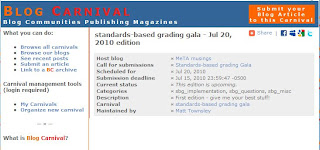
First go here.
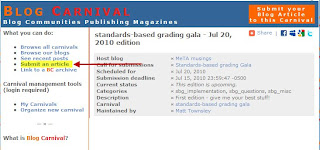
Click on "Submit an article." Edit: As Denise pointed out in the comments, you could also click on the GIANT ORANGE BUTTON in the top right corner. That would work too.
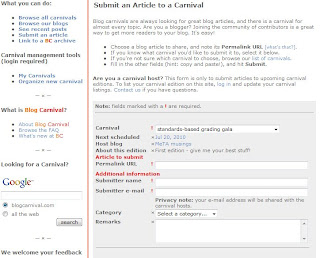
Fill out the form, submit it, and you're all done. Make sure you submit the permanent link to the exact post you want to feature, not just your home page.
They don't have to be brand new posts. However, please only submit your own posts. If you see one you like, comment to the author and tell them to submit it. I have no idea how many submissions we'll get so you may or may not be in the first carnival. This is the first one, so spread the word. We have no idea what we're doing so we may need to clarify some rules later. I'll update this post as needed.
First go here.

Click on "Submit an article." Edit: As Denise pointed out in the comments, you could also click on the GIANT ORANGE BUTTON in the top right corner. That would work too.

Fill out the form, submit it, and you're all done. Make sure you submit the permanent link to the exact post you want to feature, not just your home page.

They don't have to be brand new posts. However, please only submit your own posts. If you see one you like, comment to the author and tell them to submit it. I have no idea how many submissions we'll get so you may or may not be in the first carnival. This is the first one, so spread the word. We have no idea what we're doing so we may need to clarify some rules later. I'll update this post as needed.
Subscribe to:
Posts (Atom)