Showing posts with label argument. Show all posts

Tuesday, May 7, 2013

Scientific Writing Scaffolds

As a department we've been working on different writing scaffolds. We use Constructing Meaning as a school which I think is mostly good. We've tried all kinds of different writing frames with varying degrees of success. Most of these come from Constructing Meaning. I'm going to take you in chronological order.

This was one of our first attempts.
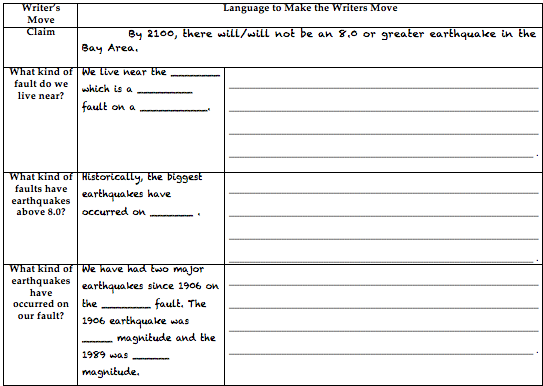
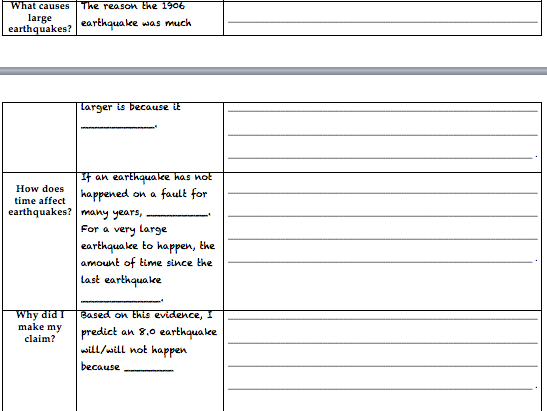

It was our sixth graders' first or second try at extended science writing. The ease of entry here was very high. The downside is obviously that it is mostly fill in the blank. Except for the last frame there wasn't a lot of room to move. Also the writing itself is pretty clumsy.

We pulled two main lessons from this.

1. Start with a graphic organizer or build the template together. The tool made the writing process too invisible which is almost always a bad thing. The counterpoint to that argument is that we got the writing done first and then we could go back and deconstruct the setup. As a first attempt for the students, this might have been the way to go.

2. The academic support words were also too invisible. Constructing Meaning calls this the "mortar." We want students to gain flexibility with the mortar so they can use it on their own.

Next attempts:


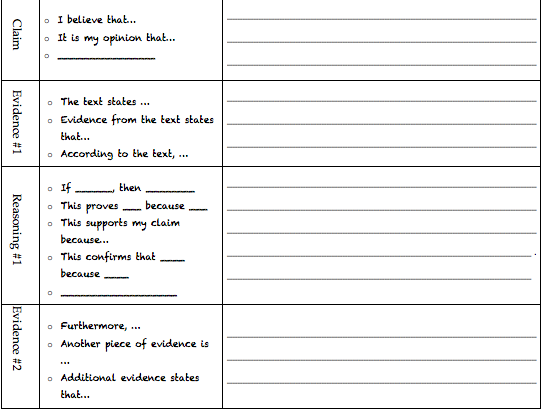
This is just the first page but the back is similar. In this one we kept the headings on the side to highlight the purpose. We also pulled out the academic support words and gave them choices. This is probably our most used format. We've also been integrating in rebuttals so that's been very nice.

Below is an even more generalized example. The topic sentence is removed. The only things that change here are the word bank and perhaps some of the support words. I don't know what the topic was but the bio people can probably take a good guess.
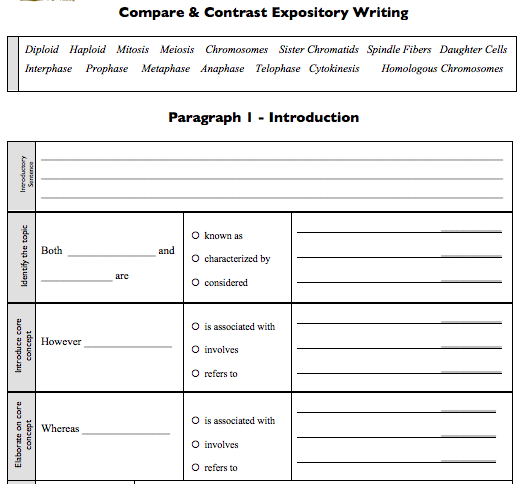


We go back and forth about word banks. We've been happiest with "you can use all, some, or none of the words but if you're using all or none you're probably doing something wrong."

Most recently we gave all of our sixth graders a prompt from the textbook about whether or not the government should provide flood insurance. This came as part of a literacy unit we did where they read multiple articles with opposing viewpoints. The other sixth grade teacher and I approached it differently. Hers:


On my end, all they got was a graphic organizer. Below is the bottom portion. The rest was two more sets of the argument/counterargument/reasoning triangles. They provided an argument and counterargument and for the reasoning they wrote about which side was more convincing.


I put the claim at the bottom because I wanted them to go through each argument first before deciding on a claim. The numbers correspond to the sentence order in their final paper. I also provided about two dozen different sentence starters they could choose from (if needed). For example, "An argument in support of government provided flood insurance is_____. Others might respond that________. ___________ is more convincing because_______________."

Their claims I limited to "The government should/should not provide flood insurance." They could include a qualifying statement though such as, "The government should provide flood insurance but only if...."

I was very happy with the results here. It balanced structure and freedom pretty nicely. For this assignment we also engaged in a class debate first and students were able to gather arguments/counterarguments from the debate. In their papers, I asked them to cite other students as sources of arguments or counterarguments.

If there's anything I've gained from the last couple of years where I've focused on writing it's that speaking comes first. I can't stress that enough. Most of the tools above work just as well for speaking.

Wednesday, January 30, 2013

Reasoning in Context

First off, the best writer on inquiry might be an electronics teacher at a technical school in the far reaches of Canada. If you haven't checked her blog yet (despite my multiple recommendations), do so now and thank me later.

I wanted to get down some things I've been thinking about with argument and specifically with Reasoning in the Claim Evidence Reasoning format that I use. It's pretty fuzzy still.

In an earlier post I cited Berland and Reiser's three reasons for making a scientific explanation:

  1. Sensemaking
  2. Articulating
  3. Persuading
This year I've been reflecting on the changes I need to make to how my class approaches a written or verbal explanation depending on which of these three purposes is our focus.

Reasoning is hard. There's no getting around that. I think I've been making it harder on my students though because I've been using "reasoning" as an umbrella term for "the part that requires a lot of thinking." Brian, as always, was ahead of me here when he commented on the distinction between argument and explanation.

What I've been learning is that I need to be more explicit (ongoing theme alert!) and identify for my students what reasoning means in context. 

Examples:

When we're engaged in a launch activity and students are using evidence to construct a claim, they're primarily focused on sensemaking. In this case, when I ask them for their reasoning, I'm really asking them to explicitly connect their evidence and claim in a consistent manner. I would expect my students to explain the patterns in their data and what those patterns might mean.

In a written prompt or lab practicum, I'm asking students to articulate their content knowledge. This is a test of what you've learned so far. In this case, when I say reasoning what I really expect is for my students to link scientific principals from class to whatever is on the page in front of them.

In whole class discussion and whiteboarding roundtables, we're engaged in persuading. Depending on the context, I would expect some combination of the above. But I would also expect you to directly address the opposing viewpoint and explain why your claim is better in some way.


It's also important for middle schoolers, and probably all ages, to understand that these different types of reasoning wouldn't just differ in content, but also in language. Google around and you can find lists of words that would appear in persuasive writing and expository writing. I use a lot of sentence frames and starters, but it's also a good self-check for students to go back and look for certain key words. I've got a couple of examples I'll put up in future posts.


Thursday, June 7, 2012

Burden of Proof

Brian Frank has a post where he talks about standards-based grading and evidence.
In a grading system where you take away points, evidence of misunderstanding and lack of evidence for understanding are both punishable offenses.  Standards-based grading, however, focuses our attention to confirming evidence of understanding.
I've had some recent posts stating that Argument is one of the pillars of science education. Here's where we get back to alignment. As Brian points out, one of the tenets of SBG is that the burden of proof rests with the students. Again to quote Brian:
The students isn’t punished for not labeling things the way you want them to; they simply can’t be given credit for understanding things for which they have provided no evidence. Maybe they will show that evidence later by labeling forces the way you want; or maybe they will show you evidence of understanding in a different way.
If we believe that one of the fundamental goals of science education, and indeed all education, is to teach students how to argue, then your grading system should align with that value.

I left a comment on Brian's blog with a link to this paper called Faculty Grading of Quantitative Problems: A Mismatch Between Values and Practice. This is by no means a rigorous academic paper but it has some points that are worth sharing.
If students are graded in a way that places the burden of proof on the instructor (as 47% of the earth science and chemistry faculty did), they will likely receive more points if they do not expose much of their reasoning and allow the instructor to instead project his/her understanding onto the solution. On the other hand, if they are graded in a way that places the burden of proof on the student to either demonstrate his/her understanding or produce a scientific argument, they will receive very few points unless they show their reasoning. Most instructors tell students that they want to see reasoning in problem solutions, however students quickly learn about an instructor’s real orientation towards grading by comparing their graded assignments with those of their classmates, or by comparing their own grades from one assignment to the next.
I love this idea of burden of proof. If we place the burden on the teacher, we need to interpret what the student means and students are encouraged to leave out reasoning because that might end up deducting points. I'm reminded of Scott McCloud's concept of closure in comics. We end up filling in the blanks between panels.1

If we place the burden on the student, the answer is simple. Why do you need to label forces in this way? I don't know if you know it until you show me.


1: I'm talking reasoning and argument here. Don't even get me started on the massive equity issues students confront when we fill in the blanks.


______

I've also got another post up at ASCD Inservice. This one is based on a Robyn Jackson seminar and is a small modification I'm making on teaching compare and contrast. It's on increasing rigor and if I'm going to stay on topic I'd say students will need to understand and negotiate with what constitutes acceptable proof of understanding. That is, if all I do is give students pre-written tests, I've placed a ceiling on what my students understand of proof. (Full disclosure: I get paid for these posts)

Thursday, May 17, 2012

Argumentation part 2


continued from part 1

Three suggestions:


1. I stole whiteboard round robins from Argument-Driven Inquiry (there are some good resources here. Try the first link under Papers for an overview). Instead of doing whole class discussion around group results, I have kids set up their whiteboards. One person stays behind while the rest of the group rotates from table to table to hear what each group found out. The roaming kids have a paper where they record some of the basic details from the other groups and it asks them to evaluate and respond to what they hear. Sorry. I wanted to post an example but I seriously can't find a single one. I don't know why. I know in the past I've asked them to comment on whether this confirms or contradicts their own findings, the quality of the experimental design, and suggestions for what might make their argument more convincing. We struggle with evaluating the quality of the argument. It's an ongoing thing.

After returning to their tables they are given the chance to revise their claim or reasoning and if I'm really on it that week, they can design a follow-up. The ADI folks suggest a presider to summarize the findings of the class. I've never tried that.

In hindsight, I think it would be kind of awesome to have students cite other groups in their write-ups just like in a scientific paper. "According to Lopez, Lee, and Silva........."or maybe just have them cite and end note. Or include a section in their CER papers for rebuttals where they specifically attempt to rebut a different group. Hmmm. Something for me to try next year.

2. ADI also has a nice double-blind peer review suggestion. I do standard peer review but haven't added the double-blind aspect. I think that could be interesting. There's a long template here and on page 5 here (both links from here). I think those are a bit unwieldy for MS or even HS kids. For their chemistry final I had my students attempt to explain the candle and flask demo. For peer review we used this:

I tailored it based on what my students specifically have trouble with. It was helpful but not amazing. Next year I'd add something more specifically aimed at persuasiveness (see? We're good with inquiry and content knowledge. Bad with argument). Also, like any peer review, if everyone was weak at something we didn't add a lot of value by peer reviewing. We have a lot of trouble with logical consistency. For example, saying that the heat made the air spread but then later arguing that the water was cold so that's why it spread into the flask. I think having students flow chart their arguments might help but this is something I struggle with. Any suggestions would be great.

3. Conditional language is critical. Once I, as the teacher and scientific authority, tell the students that matter is conserved in a chemical reaction their brains shut down. It sounds dumb and too New Age-y for me and I don't have any hard evidence to back this up. All I know is the longer I stick with "might be" and "could" or even "probably" I can see my students still working hard to convince me that they're correct. (The downside is I had a frustrated student blow up at me this year because we "never settle anything" and so he's "not sure what's right and what's wrong." There's a balance I'm still working to find.)


--------------
Brian left a comment pointing to another paper arguing that we need to make a clear distinction between argument and explanation. I agree to the point where we need to understand that giving opportunities to explain is not the same as giving opportunities to argue. I'm less sure how important it is to teach to students the semantic difference. To clarify, I'm sure it's important, I'm just not sure what it's more important than and what I would then cut out.

Claim Evidence Reasoning - Argumentation

Theoretical in part 1. Practical in part 2.


In Making sense of argumentation and explanation by Berland and Reiser, the authors argue that scientific explanations have three purposes: 1. sensemaking, 2. articulating, 3. persuading.

They summarize these nicely as constructing arguments, presenting arguments, and debating arguments.

I like these. A lot. The authors don't treat these three purposes as separate domains but argue that each of these serve to strengthen the other.

Other than being really interesting, why is this relevant? From page 31:
We suggest that viewing student work in terms of these three instructional goals can clarify students' successes and challenges in constructing and defining scientific explanations and consequently inform the design of supports for this practice......we suggest that each aspect of the practice may require different types of support for students.
This has very broad implications about everything from assessment to scaffolds to how to structure the entire class. The authors studied the CER framework and decided it was good for purpose 1 and 2 but not so much for 3. My personal experience backs that up. From the abstract:
Through this analysis, we find that students consistently use evidence to make sense of phenomenon and articulate those understandings but they do not consistently attend to the third goal of persuading others of their understandings. Examining the third goal more closely reveals that persuading others of an understanding requires social interactions that are often inhibited by traditional classroom interactions.

If someone were to ask me what the three legged stool of science education is, as of May 2012 at least, I'd say content knowledge, inquiry, and argument.  You can't have a complete science education without all three.

In science education, argument is our weakest area. I know for me, it wasn't even something I thought about until last year.

This is my way of qualifying any suggestions I have. I'm still new at this. I don't have a lot to offer.

What I can tell you is that if you want students to engage in argumentation, you need to give them something to argue about. Sounds obvious right? But if I explain a topic, then we do a confirmation lab, and then I expect students to engage in argument about that topic, I'm setting myself up for all sorts of disappointment. I haven't given them anything to argue about. I've just given them an opportunity to show me how well they've memorized what I've said.


I've got three other suggestions which I'll break into the next post.

Wednesday, April 11, 2012

Claim Evidence Reasoning - More on Reasoning

Mylene asked about helping with the reasoning part of Claim, Evidence, Reasoning. (Mylene - get on twitter already. We could just talk about it.) Here's the relevant snip:
One thing I'm really struggling with is the concept of "logic" or a conclusion following from its premises. It's hard for my students to understand what I mean by this and it's hard for me to explain in other terms. So far, it appears that their definition of "logical" is something along the lines of "familiar" or "what I was expecting." Any suggestions? How do you handle reasoning that is preposterous or that makes leaps of faith?
This is definitely the hard part. I don't have any magic bullets, but I can tell you where I am right now.


1. Faulty reasoning is most often due to a lack of content knowledge. At the beginning and middle of a unit, this is expected. Honing reasoning as we go is one of our primary goals.

If things aren't going well though, my best advice would be to narrow the question. Broader questions are usually more complex. I started conservation of mass with, "What happens to atoms in a chemical reaction?" (Actually, the question was about why ice melts when you heat it but paper burns) and kids were flying all over the place. They generated their own claim and designed their own experiments and it was a disaster. There was no real way to differentiate through experiment most of their claims (atoms are being fused together, atoms are exploding, atoms turn into heat). I rebooted with whether atoms are destroyed or not in a chemical reaction and it worked much better. We all did a similar experiment and students were able to make a well-reasoned argument that atoms weren't destroyed.

The counterpoint is that I start other topics, like kinetic molecular theory, very broadly. I can't say for sure why some topics need to be narrower but it is some combination of how much background knowledge students come in with, how well our classroom experimentation can differentiate between competing claims, and how much time I'm willing to devote to testing competing ideas.

2. There are mechanical issues. For MS kids, sentence frames and starters go a long way. Be sure to fade them as you go. Another teacher at my school has a lot of success with sentence starters in group discourse. He posts them at his tables. Instead of CER, some teachers like C-ER-ER-ER where you give a reason after each piece of evidence.

3. Ask students to explain ahead of time what different results would mean with regard to the claim. Before they could start the experiment to test if atoms are destroyed or not, my students needed to explain to me that if the bottle got lighter, it meant atoms are being destroyed. If it weighed the same, they weren't. If it weighed more, something else was going on that we couldn't explain (this is an important and often overlooked step). In essence, I was locking them in to a reasoning. Is that preventing them from doing any thinking? I say no because I'm still asking my students to reason, it's just the timing that changes. If I do it after, students more often construct weird explanations for the results and engage in all kinds of magical thinking and confirmation bias. This is assuming the purpose of a lab is to test a specific claim. Sometimes a lab is just to get ideas rolling in which case we do our reasoning after. [Edit: Have your students sketch a "prediction graph" on their whiteboards ahead of time.]

4. Distinguish between reasoning and introducing a new claim. It is hard for students to see when their reasoning is backing up a claim and when they're making a brand new assertion. I don't have a good method for this other than continually asking them to go back to what their claim actually predicts. It's also important to help them with the idea that a single experiment doesn't have to explain everything. We burn paper and weigh it and it weighs the same. That only tells us that the atoms aren't being destroyed. That means we often need to use multiple pieces of evidence to converge on a single, more complex, explanation.

5. Differentiate between logical/scientific reasoning and reasoning from evidence. I think this idea came from a paper by Deanna Kuhn2 but I'm not sure. The part I really latched onto was that students come into experiments in science class with the idea that something has to covary. We're measuring this and manipulating that so clearly there's a relationship between the two. Students aren't asked to actually look at the data created but simply to reason about the science involved. In hindsight, this is certainly true in most of my classes. I run some kind of amazing science lab where the null hypothesis is always rejected. My takeaway is that occasionally students need to be doing experiments where no relationship will actually be found. I've gotten better at this both in intentionally designing them in and allowing students to run an experiment that I know will result in no relationship. The first few attempts at this what do I find? Students can ALWAYS find a relationship. It's a long slow process of breaking this habit.

The other insight I got from that paper was that students don't really understand measurement uncertainty. I definitely find that to be true. I like Geoff's approach but I don't really do anything about this other than hate how I don't do anything about it.


This is getting long. I'm going to stop here. I've got two more posts on CER in my drafts but history has shown I'm awful at following up on promised posts.


-------

1: The flipside is the argument that more attention to persuasion will lead to better arguments. I'll write more on this next time. (EDIT: This footnote doesn't go anywhere but I'll keep it to remind me.)
2: I hadn't heard of the Education for Thinking Project until I googled her for a link. Looks right up my alley.

Friday, April 6, 2012

Claim Evidence Reasoning

By far, the biggest shift in my teaching from year 1 to year 7 has been how much emphasis I now place on evaluating evidence and making evidence-based claims.

I blame inquiry. Not inquiry in the generalized, overloaded, science teaching approach sense. Just the word. "Inquiry."

Even now, when I hear the word "inquiry" I still think mainly of asking questions and designing experiments. A bad side effect of thinking in this way was that I would spend far too long having students ask questions and design experiments and very little time evaluating evidence and generating claims. On good days, when we miraculously got cleaned up before the bell, I might have spent 10 minutes at the end of class telling students what they were supposed to have figured out and students would answer questions like, "Explain how you know mass is conserved in a chemical reaction." (Answer: Because you just told me by asking that question.)

We were very busy and very engaged and learned very little.

There are a few structures I've been using to help shift the focus on the class to analysis and argument. One of them is the claim-evidence-reasoning framework. I'm not sure who the originator was but most of what I do came from Katherine McNeill who has published a ton on it. She wrote a book too.1


Claim-Evidence-Reasoning (pdf and pdf) is a framework for writing scientific explanations. Occasionally I use it as a probe in the style of Paige Keeley. After most labs, students are asked to write about a paragraph worth in this format and a more extended version when we wrap up a unit.

 As part of their lab handout they get a prompt that looks like this:


As the year goes on I remove most of the scaffolds until ultimately the students just get a prompt or question.

I've been happy with it. There's a fourth step, Rebuttal, which I've never gotten off the ground. 

I like frameworks a lot. I like having specific language I can refer to over and over. In a typical initiate-respond exchange, I follow-up by ask students for their reasoning. When students want to whine or talk back to me, I get to ask them, "What is your evidence? How does that evidence support your claim that I'm the most annoying teacher in the world?" (Evidence #1: The fact that I ask that question.)

The key to implementation is that the structure of the class really has to be designed around C-E-R. Even if I'm just direct teaching something, I need to model how to think about the evidence that led to the claim.


I also give my students a whiteboard format now. It usually looks like this:


I used to structure it in Claim-Evidence-Reasoning order but I realized students would then write their claim before they got their evidence.

McNeill uses C-E-R for essentially everything. Any major idea can be written up in that format. I think the framework works best when students truly have something to argue about. Of course, I'd say that all learning works best when students have something to argue about.

I've had a lot of success with using it when students are constructing the kinetic molecular theory or deciding if mass is conserved in a reaction or not. Why things float or sink was fun. "Is Pluto a planet?" is a good one. A lot of Dr. McNeill's papers are written around a multi-week unit designed around the question, "Are soap and fat different substances?"

I've been happy with the results. We used to spend all of our time just generating data. Now that data is being put to use.


----------------------

For more on writing, I show up in an interview in ASCD Education Update titled Improving Student Writing Through Formative Assessments. It's only for ASCD members but most of what I have to say is in Managing Feedback.


Addendum: Kirk shared a free NSTA article called Engaging Students in the Scientific Practices of Explanation and Argumentation. Berland and Reiser in particular have written a number of good articles on the topic.

1: I can't fully recommend the book. It's pretty basic and you can find most of the information from googling around for her various research papers. If you're not interested in dealing with that you might want to give it a go.