Tuesday, June 4, 2013

End of Year Letter - 2013

This is one of those posts bloggers do to remind themselves of changes to make for next year. Nothing to see here. Move along.

At the end of the year one of the things I do is go to Target and buy 100s of Thank You cards. I think the pack I bought this year was $2.99 for 50. I ask students to write a thank you to a person at the school. It is usually a teacher but can be anyone. Our "student advisor" (AKA the huge guy that yanks kids out of class) gets a lot of cards as do the people that run the afterschool program. My only rule is that it can't be to me. Some kids do only one. I think this year one student wrote five. Then I drop them in mailboxes. It's a nice thing, especially for the 6th grade teachers who assume they have been forgotten.

I showed my students the Neil Tyson "Most Astounding Fact" video as the introduction and mentioned that this is where my introduction came from. Since I asked them to write Thank Yous yesterday I also included a thank you. Then I just gave them the letter. Like Sam, ideally I'd like students to keep it in their yearbook and randomly stumble on it every few years.

I tried to keep it to one page because I'm not entirely sure 8th graders will read even that much.

I over-edited and the transitions are ugly. I also took out the more personal stuff in favor of broader stuff. I think that was a mistake. I should have definitely left in, "Future classes will look up at the ceiling, see the smoke stains, and know that we were here."


Tuesday, May 7, 2013

Scientific Writing Scaffolds

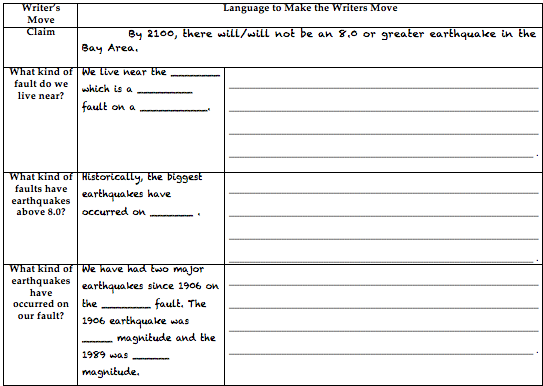
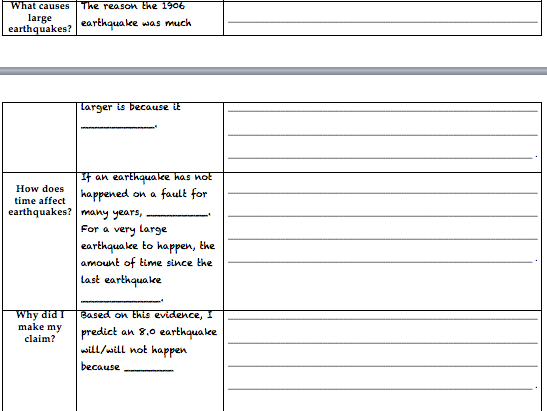
As a department we've been working on different writing scaffolds. We use Constructing Meaning as a school which I think is mostly good. We've tried all kinds of different writing frames with varying degrees of success. Most of these come from Constructing Meaning. I'm going to take you in chronological order.

This was one of our first attempts.


It was our sixth graders' first or second try at extended science writing. The ease of entry here was very high. The downside is obviously that it is mostly fill in the blank. Except for the last frame there wasn't a lot of room to move. Also the writing itself is pretty clumsy.

We pulled two main lessons from this.

1. Start with a graphic organizer or build the template together. The tool made the writing process too invisible which is almost always a bad thing. The counterpoint to that argument is that we got the writing done first and then we could go back and deconstruct the setup. As a first attempt for the students, this might have been the way to go.

2. The academic support words were also too invisible. Constructing Meaning calls this the "mortar." We want students to gain flexibility with the mortar so they can use it on their own.

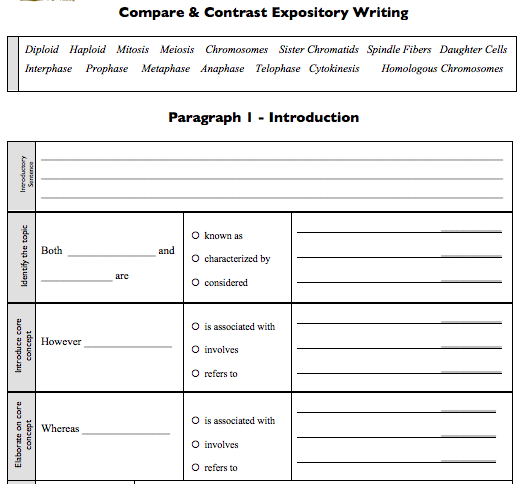
Next attempts:


This is just the first page but the back is similar. In this one we kept the headings on the side to highlight the purpose. We also pulled out the academic support words and gave them choices. This is probably our most used format. We've also been integrating in rebuttals so that's been very nice.

Below is an even more generalized example. The topic sentence is removed. The only things that change here are the word bank and perhaps some of the support words. I don't know what the topic was but the bio people can probably take a good guess.


We go back and forth about word banks. We've been happiest with "you can use all, some, or none of the words but if you're using all or none you're probably doing something wrong."

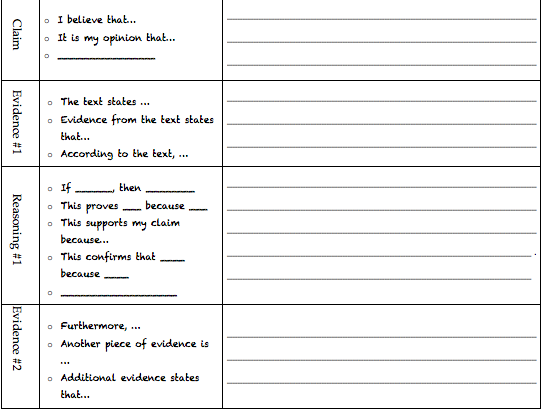
Most recently we gave all of our sixth graders a prompt from the textbook about whether or not the government should provide flood insurance. This came as part of a literacy unit we did where they read multiple articles with opposing viewpoints. The other sixth grade teacher and I approached it differently. Hers:


On my end, all they got was a graphic organizer. Below is the bottom portion. The rest was two more sets of the argument/counterargument/reasoning triangles. They provided an argument and counterargument and for the reasoning they wrote about which side was more convincing.


I put the claim at the bottom because I wanted them to go through each argument first before deciding on a claim. The numbers correspond to the sentence order in their final paper. I also provided about two dozen different sentence starters they could choose from (if needed). For example, "An argument in support of government provided flood insurance is_____. Others might respond that________. ___________ is more convincing because_______________."

Their claims I limited to "The government should/should not provide flood insurance." They could include a qualifying statement though such as, "The government should provide flood insurance but only if...."

I was very happy with the results here. It balanced structure and freedom pretty nicely. For this assignment we also engaged in a class debate first and students were able to gather arguments/counterarguments from the debate. In their papers, I asked them to cite other students as sources of arguments or counterarguments.

If there's anything I've gained from the last couple of years where I've focused on writing it's that speaking comes first. I can't stress that enough. Most of the tools above work just as well for speaking.

Thursday, April 25, 2013

Shuffle Quiz

We're in the midst of CST prep. I am bored. CST review is this weird game of picking out specific skills/topics not because they're important so much as they can be quickly recalled and practiced back to fluency.

Right now I'm leaning heavily on shuffle quizzes for my skills practice.

The basic idea is the students get a set of problems and work on them together. At spaced intervals a group member raises his/her hand and I come over. I take their papers and shuffle them up. Whoever gets their paper pulled gets asked the questions for the group. I ask the questions at the bottom and sign off when they can move on.

The only thing I did differently in these examples is that instead of everyone working the same problem, each member in a group of four was assigned a specific problem. (seat 1 did problem 1, seat 2 problem 2, etc). They split the big whiteboard into quarters and worked the problems. They took turns explaining and checking and then call me over. If this answers aren't correct I let them know and come back later. When they are working different problems I usually just ask for one problem to be explained but it's never their own.

Some use notes:

  1. These questions are pretty plain vanilla to emulate the glory of the CST but I've used this strategy for more interesting questions. The more difficult the problem, the more students are assigned. When I went to see Complex Instruction at Mission HS, the teachers used this strategy for nearly all of the group work. 
  2. It's a bit of an art to balance how many consecutive problems students should try before I need to be called over. Too many problems and students go too long without checking in. Too few and I can't sit with any one group long enough and other groups are just waiting around. For reference, my typical class is 8 groups of 4. For the density/Archimedes one the pacing ended up a bit quick but just barely. Next year I'd probably eliminate the first checkpoint because the first two sets are straight plug and chug but keep the last check point. For the graphing practice it was about right. 
  3. Since this is review, I tried to cluster them into similar problem types.
  4. This year I used A/B/C/Redo but in previous years I've done a sign off with no score or plus/check/minus. I don't have a preference. Generally I just tell them I'll come back later if a student clearly isn't prepared. 
  5. I've signed each paper and also just signed the one and had students staple them all together. Again, no preference. 


Here are some sample pics:


Notes: Graph A is the top right from this angle, Graph B is the top left, and Graph C is the bottom right. For the FBD scenario, we watched the clip on youtube earlier.


I don't know why speed-time graphs are so much more difficult for my students. I assume it's because I present position-time graphs first and they get locked in. Or maybe it's just easier to visualize changing position than changing speed. If you have any insights I'd love to hear them.

Monday, March 4, 2013

The idea is the easy part

.......and access is not a goal.


The idea is the easy part......
Audrey Watters and John Spencer both have articles up talking about the problems with TED. There is a lot there and worth a read. They hit on similar criticisms. Audrey says, "You are not supposed to interrogate a TED Talk." and John wrote, "TED Talks become a sort of Secular Scripture offering a script to fix humanity." Some of the TED ideas are bad. Some are good. That's expected.

I have a different issue. My problem isn't with TED. I happen to like quite a few talks. TED is simply mirroring our values.1

My problem is that we place too much value on the idea and not enough on the work.

Sugata Mitra has an idea. He wants to open a School in the Cloud.  Fine. Everyone has ideas. My question isn't about his idea it's about his willingness to put the work in to make it happen and keep it happening.

You've got an idea? So do a million other people. Let's stop celebrating ideas. Celebrate those standing waste deep in the muck with dirt in their nails and sweat on their face.


....and access is not a goal.

Bill Gates and Will.I.Am want everyone to have the opportunity to code.2 Ok. California wanted every 8th grader to take Algebra. They said provide access and achievement will follow. Those of us in California can tell you how that went.

Providing access is the absolute minimum that we can possibly do and still feel like we've accomplished something.


(edit: I should link this for a scholarly view on access)


1: Or at least the type of values that someone who would watch a TED talk has.
1.5: I avoided ranting about Alfie Kohn. Be proud.
2: I'm not a fan of the idea itself, but I'm talking specifically about access and opportunity as goals. Also not a fan of the School in the Cloud. Mostly seems like 'access' but with the computer. It's like opening a school with an infinite number of textbooks available and some of them talk and have moving pictures and most are focused on cats.  

Monday, February 25, 2013

Three Quotes on Identity and the Achievement Gap

I'm pushing the limits of Fair Use but I wanted to post these for my own future reference.

Dr. Camika Royal on Asa Hilliard quoted in Please Stop Using the Phrase 'Achievement Gap'
One of Hilliard's most salient arguments is the notion that the so-called achievement gap between whites, blacks, and Latinos holds white wealthy students' performance as the standard of excellence without interrogating whether or not their performance is worthy of comparison. Instead of asking if how they performed is excellent, the inter-racially comparative nature of the "achievement gap" suggests that blacks, Latinos, Native Americans, special education students, and those receiving free and reduced-priced lunch should do whatever white students are doing.

Dr. Rochelle Gutierrez (originally from East San Jose!) in A "Gap-Gazing Fetish" in Mathematics Education. Problematizing Research on the Achievement Gap, p. 359.
...the (achievement gap) lens sends an unintended message that marginalized students are not worth studying in their own right—that a comparison group is necessary. Such a framing further engrains whiteness and middle-to-upper income as a norm, positioning certain students and their cultures as deviant.

Andrew Solomon in Far from the Tree


Background: Vertical identities are those identities inherited to some degree from parents. They may be genetic but also shared cultural norms. Horizontal identities are formed when someone has a trait foreign to his or her parents and must "acquire identity from a peer group." The book is about parents and children but I think you can also apply this to school relationships as well.

Most deaf children are born to hearing parents, and those parents frequently prioritize functioning in the hearing world, expending enormous energy on oral speech and lipreading. Doing so, they can neglect other areas of their children's education. While some deaf people are good at lipreading and produce comprehensible speech, many do not have that skill, and years go by as they sit endlessly with audiologists and speech pathologists instead of learning history and mathematics and philosophy. Many stumble upon Deaf identity in adolescence, and it comes as a great liberation. They move into a world that validates Sign as a language and discover themselves. Some hearing parents accept this powerful new development; others struggle against it." (pages 2-3)
Vertical identities are usually respected as identities; horizontal ones are often treated as flaws.(page 4)
Wondering how my teachers could have done this, I thought that someone whose core being is deemed a sickness and an illegality may struggle to parse the distinction between that and a much greater crime. Treating an identity as an illness invites real illness to make a braver stand. (page 13)
Three quick thoughts:

I used to think that our fixation on the "achievement gap" was a form of microaggression (see this post, this vid and this tumblr) but I've been underestimating the impact.

How much of our time is spent trying to 'fix' a student when what we're really trying to do is make a student more like us?

And with a nod to Dr. Gutierrez, I will give endless blog love to the first person who, in a staff meeting about the 'achievement gap', raises his/her hand and asks, "Yes. What are we planning to do to catch our White students up to our Asian ones?"


_________
Thanks to Bryan and Raymond for the Gutierrez articles and for the Hangout and Grace for recommending the Solomon book.

Tuesday, February 12, 2013

Miss A

I'm always a bit surprised that more teachers haven't heard of Miss A. It's one of those things that keeps me going when times get rough. If you haven't, you should read this speech [pdf] by Dan Fallon for the overview. Read it again whenever you start feeling like what you do doesn't matter.

Ben was good enough to send me the original 1978 Harvard Education Review article. The lead author was a former student of hers and also wrote this response to a newspaper letter after she passed away.

(Miss A's real name was Iole Appugliese—Miss Apple Daisy to her students. There's a little more biographical information in A Tribute to the Great Montrealers.)


PS - If any of your libraries happen to have a copy of a Canadian Reader's Digest from September 1976 there's an article called Miss Apple Daisy about her that I haven't read. I'd ask you to send it to me but that would likely require you to pilfer some microfiche.

Sunday, February 10, 2013

Institute for Teachers of Color Committed to Racial Justice


Update 5/7/13: I'm in. If you're going I'll see you there.


San Jose State is hosting the Institute for Teachers of Color Committed to Racial Justice. It's $150 and there's a brief application process that includes a few extended response questions. I've applied but I won't know for a few months if I'm in. Here's the body of the email I received (Thanks Kari):


Keynotes Confirmed:Dr. Tara Yosso, Chicana/o Studies, UCSBAllyson Tintiangco-Cubales, Asian American Studies and Educational Leadership, SFSU 
In California, students of color comprise over 70% of the public school population, but teachers of color make up less than 30% of the teaching force. With barriers such as limited resources, testing pressures and culturally-disconnected mandated curriculum, teachers of color with a commitment to racial justice face many challenges in realizing their vision, and can feel isolated in their work. 
June 19-21, 2013, San José State University is hosting the third annual Institute for Teachers of Color Committed to Racial Justice, a three-day conference to support the development, success and retention of teachers of color struggling to achieve racial justice in schools. It is intended as a community building, professional development space for teachers of color to explore the racial climate of their schools, receive training to navigate these realities, and strategize how to create racially transformative classrooms and schools. We are also accepting applications from school administrators of color and teacher educators of color who are interested in building alongside teachers.  
The cost for attending the Institute is $150, which includes breakfast, lunch and materials for all three days (a limited number of scholarships are available for those who are not receiving district funding). Applications should be submitted by April 1, 2013 and we will notify applicants by early May. If you are interested in attending this Institute, please complete the application through the following link: 
www.surveymonkey.com/s/Instituteforteachersofcolor  
We are looking for teachers, school administrators and teacher educators of color who:
• Are committed to racial justice.
• Work at schools serving a significant population of students of color.
• Want to build a like-minded community.
• Have specific needs that can be met by the Institute.  
We are also hoping to achieve racial and gender balance among participants to represent the diversity of teachers, school administrators, and teacher educators of color. Please submit any inquiries to Dr. Rita Kohli at rita.kohli-REMOVE-ME-@-sjsu.edu.
I altered the email address at the end for the scrapers. Take out any dashes and the REMOVE ME.


If this is too far for you, I've also heard good things about:

Free Minds, Free People on July 11-14 in Chicago
New York Collective of Radical Educators on March 16 in NYC

Some brief googling also led me to:

Northwest Conference on Teaching of Social Justice October in Seattle
Conference on Equity and Social Justice on March 2 in New Paltz, New York
Conference for Social Justice in Education on April 20 in the Channel Islands, CA.

I haven't heard anything about those though.


If there are any other conferences you'd recommend on social justice leave it in the comments.