On Saturday, Sunday, and Monday I'll be blogging the ASCD Annual Conference in San Francisco. Check back on this blog, and a few others, this weekend. I'll try to shoot out some quick posts after each session and a few longer ones later when I've had time to reflect and digest. Saturday is assessment heavy but I promise to be more diverse on Sunday and Monday.
If you're going to be there, say hello.
I'm going mainly on session title and a few recommendations but I'm planning on switching up if it turns out they're selling something.
As of now, here's my Saturday. If you've got any inside info (good/bad) about the presenters or presentations let me know. The program booklet is online:
8:00 (wait...what?!?!? 8:00 in the morning???)
Option A:
1129 Conferring with Students: Practical Strategies that Close the Achievement Gap - Patricia Reynolds from the NYDOE.
Option B:
1102 Beyond Reteaching and Regrouping: Using Data to Dramatically Improve Instruction - Trent Kauffman, Education Direction
10:00
Made to Stick with Chip Heath. (Loved this book and also Switch.)
The over/under on how many times I make the joke, "I won't take notes on this, because I'll just remember it." = 6.5
1:00
Option A:
1222T Fair and Meaningful Grades for Exceptional Learners - Thomas Guskey
Option B:
1254 Doing Whatever it Takes: Barrington's Journey to Extraordinary - I really wanted to go to this one because I've been trying to get my school to put in a flexible time schedule, but I can't pass up on Guskey. If you're going, let me copy your notes.
3:30
Option A:
1302T Leading by Design: Leading Understanding by Design-Based Reform at the School Level - Grant Wiggins
If Wiggins ends up just reading from his book I'm going to sneak out to go to
1347T Boosting the Cognitive Complexity of Instructional Tasks and Assessments - Rebecca Stobaugh, Western Kentucky University
5:15
I'm pretty meh about this time slot. I'll take any recommendations.
Option A:
Finding and Keeping Great Teachers - Scott Herrman, Margaret Clauson
Option B:
Interventions to Improve Students' Cognitive Abilities - Rhoda Koenig
I'll finalize my Sunday and Monday schedules after I've had a chance to get the inside scoop from conference vets.
Assuming wifi is working, you can follow me on twitter. I'll be using the #ASCD11 hashtag for updates.
Thursday, March 24, 2011


Monday, March 21, 2011
Why Teachers Like Me Support Unions
"Hey Jason, you must be pretty interested in what's happening in Wisconsin."
"Yeah of course."
"Good that people are finally standing up to the unions."
"Yeah, it's......Wait......what?"
"The unions. You always seem pretty anti-union."
"Why's that?"
"Well you're always complaining about how they're getting in your way."
.......
I can't deny that last statement. I do. I complain about my union regularly. I've fought with them, actively or passively, numerous times over my career.
But I support unions and I especially support my own union. As soon as I saw Stephen's post about edusolidarity I knew I'd do it.
I have this go-to phrase. I use it all the time when I'm making a decision. In fact, it overrides most other considerations.
"It'll help our students."
When I hear it, I can't say no.
Three years ago, we never filled an SDC class position. Instead of hiring a substitute, I agreed to roll the SDC class into my newcomers (non-English speakers) class. I did it because I thought it would help our students.
Last year, we had an open position in science. I alternated teaching every single section of science through the week while also creating lessons for the rotating subs. I was responsible for more than 300 students for a few months. I did it because I thought it would help our students.
This year, we had two hours a week added to our schedule. No warning. No increase in pay or other types of compensation. I went along with it. I did it because I thought it would help our students.
And this is where my union and I fight. We disagree because I am only thinking about my students. The union? The union is thinking about me. They're protecting me from me. Iwon't can't say no. I keep pushing and pushing. My union pushes back. They tell me that the district could fill that open spot. We shouldn't have our schedule arbitrarily lengthened without something in return. They tell me to hold firm and the school will do what needs to be done.
So we fight. And I complain.
And my friends and family only hear the "unions are bad" narrative.
But without my union I would not be here. Without my union I would have burned out long ago. I see 150 kids without a teacher and I don't think, I just act. The union kept pressure on, and the next year, we found an SDC teacher. The union didn't let my school forget about the open science position and so we had a new teacher by January. The union helped us get some of that added time back for staff collaboration.
My union thinks about me so I can think about my kids. I support my union because I can't support myself.

"Yeah of course."
"Good that people are finally standing up to the unions."
"Yeah, it's......Wait......what?"
"The unions. You always seem pretty anti-union."
"Why's that?"
"Well you're always complaining about how they're getting in your way."
.......
I can't deny that last statement. I do. I complain about my union regularly. I've fought with them, actively or passively, numerous times over my career.
But I support unions and I especially support my own union. As soon as I saw Stephen's post about edusolidarity I knew I'd do it.
I have this go-to phrase. I use it all the time when I'm making a decision. In fact, it overrides most other considerations.
"It'll help our students."
When I hear it, I can't say no.
Three years ago, we never filled an SDC class position. Instead of hiring a substitute, I agreed to roll the SDC class into my newcomers (non-English speakers) class. I did it because I thought it would help our students.
Last year, we had an open position in science. I alternated teaching every single section of science through the week while also creating lessons for the rotating subs. I was responsible for more than 300 students for a few months. I did it because I thought it would help our students.
This year, we had two hours a week added to our schedule. No warning. No increase in pay or other types of compensation. I went along with it. I did it because I thought it would help our students.
And this is where my union and I fight. We disagree because I am only thinking about my students. The union? The union is thinking about me. They're protecting me from me. I
So we fight. And I complain.
And my friends and family only hear the "unions are bad" narrative.
But without my union I would not be here. Without my union I would have burned out long ago. I see 150 kids without a teacher and I don't think, I just act. The union kept pressure on, and the next year, we found an SDC teacher. The union didn't let my school forget about the open science position and so we had a new teacher by January. The union helped us get some of that added time back for staff collaboration.
My union thinks about me so I can think about my kids. I support my union because I can't support myself.
Friday, March 11, 2011
One Test to Rule Them All
Nearly 60 years ago, an anesthesiologist named Dr. Virginia Apgar devised a simple test that all parents are familiar with. The Apgar test looks at five criteria to quickly determine the health of a newborn. A healthy newborn will generally score between 7 and 10.
The story of Dr. Apgar's test is an important lesson.
On the face of it, the Apgar test is ludicrously simplistic. In theory, a baby could have no pulse but still score a perfectly healthy 8.
But the Apgar test is good enough. And more importantly, it's better than nothing. Because that's what doctors used to have.
In the book Better, my man crush Atul Gawande states, "the score turned an intangible and impressionistic concept—the condition of new babies—into numbers that people could collect and compare (p. 187)."
Basically, doctors now could tinker and gather the results to see what worked. There's a lovely passage about how doctors are supposed to be "evidence-based" but in obstetrics the doctors just tried stuff out and looked to see if results improved.
They had a number and if it went up, they knew they probably did something good. If it went down, then back to the drawing board. Before the Apgar test, 1 in 30 newborns died at birth. Now, it's 1 in 500 (p. 187).
but.....
Gawande also points out that the number of Cesareans has increased dramatically. In part, because of that all important Apgar score. He uses the phrase "tyranny to the score" here, which I love. Doctors, being the type A overachievers that they are, seek to maximize their score as much as possible. Sometimes they do so at the expense of other considerations. Again, quoting, "While we rate the newborn child's health, the mother's pain and blood loss and length of recovering seem to count for little. We have no score for how the mother does....(p. 198)" Being the goodteacher doctor that he is, he goes on to suggest multiple measures.
So what do I take from all this? I used to spend hours creating and revising the perfect assessment. I'd stress about word choice. I'd wonder if I was giving too much away or not enough info. I'd try for that perfect balance of academic vocab and accessible language. I'd try to cram in 60 questions in 50 minutes or have them write a full lab report in complete silence.
Except that there aren't any perfect assessments. What's perfect for Student A is highly flawed for Student B. It does not exist. But there are certainly better and worse assessments. So like the Apgar test, I try to make my assessments good enough. Multiple "pretty good" assessments give a more complete picture than any single "great" one possibly can.1 And NEVER EVER let any one score dictate everything.
1: Falling in love with a single assessment, lesson, lab, demo, whatever... is one of the cardinal sins that very good teachers make. I know I can become enamored with a lab and stop being critical of it and working to improve. I start to think it does more than it actually does. And yes, I try to work to keep my SBG love in check.
PS - I've gotten more out of the Atul Gawande's books than any other of the "not in education" gurus we end up reading, like Dan Pink, Malcolm Gladwell or Jim Collins. I keep meaning to blog about the chapter he wrote on cystic fibrosis care. Best chapter ever. Go to the library this weekend and read it. The chapter is titled The Bell Curve and it will burrow deep into your brain.
The story of Dr. Apgar's test is an important lesson.
On the face of it, the Apgar test is ludicrously simplistic. In theory, a baby could have no pulse but still score a perfectly healthy 8.
But the Apgar test is good enough. And more importantly, it's better than nothing. Because that's what doctors used to have.
In the book Better, my man crush Atul Gawande states, "the score turned an intangible and impressionistic concept—the condition of new babies—into numbers that people could collect and compare (p. 187)."
Basically, doctors now could tinker and gather the results to see what worked. There's a lovely passage about how doctors are supposed to be "evidence-based" but in obstetrics the doctors just tried stuff out and looked to see if results improved.
They had a number and if it went up, they knew they probably did something good. If it went down, then back to the drawing board. Before the Apgar test, 1 in 30 newborns died at birth. Now, it's 1 in 500 (p. 187).
but.....
Gawande also points out that the number of Cesareans has increased dramatically. In part, because of that all important Apgar score. He uses the phrase "tyranny to the score" here, which I love. Doctors, being the type A overachievers that they are, seek to maximize their score as much as possible. Sometimes they do so at the expense of other considerations. Again, quoting, "While we rate the newborn child's health, the mother's pain and blood loss and length of recovering seem to count for little. We have no score for how the mother does....(p. 198)" Being the good
So what do I take from all this? I used to spend hours creating and revising the perfect assessment. I'd stress about word choice. I'd wonder if I was giving too much away or not enough info. I'd try for that perfect balance of academic vocab and accessible language. I'd try to cram in 60 questions in 50 minutes or have them write a full lab report in complete silence.
Except that there aren't any perfect assessments. What's perfect for Student A is highly flawed for Student B. It does not exist. But there are certainly better and worse assessments. So like the Apgar test, I try to make my assessments good enough. Multiple "pretty good" assessments give a more complete picture than any single "great" one possibly can.1 And NEVER EVER let any one score dictate everything.
1: Falling in love with a single assessment, lesson, lab, demo, whatever... is one of the cardinal sins that very good teachers make. I know I can become enamored with a lab and stop being critical of it and working to improve. I start to think it does more than it actually does. And yes, I try to work to keep my SBG love in check.
PS - I've gotten more out of the Atul Gawande's books than any other of the "not in education" gurus we end up reading, like Dan Pink, Malcolm Gladwell or Jim Collins. I keep meaning to blog about the chapter he wrote on cystic fibrosis care. Best chapter ever. Go to the library this weekend and read it. The chapter is titled The Bell Curve and it will burrow deep into your brain.
Thursday, February 10, 2011
Make it Right
We've got about 6 weeks before our state tests so I just sent out an email to the other two teachers in my department detailing a list of standards they need to teach and how those standards will be assessed. I had to say things like, "Skip inertia because it is not tested." I'm feeling a little dirty right now. On the plus side, it reminded me of one of my favorite test prep techniques.
I call it Make it Right but I'm sure it goes by other names. The instructions are simple. After selecting the correct answer the students need to rewrite the question so that the other choices now become correct. Example:
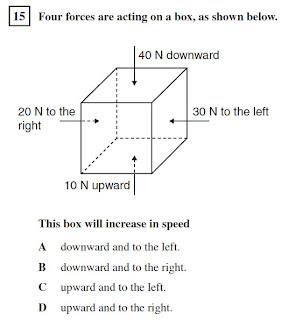
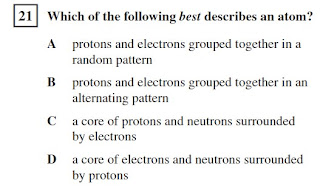
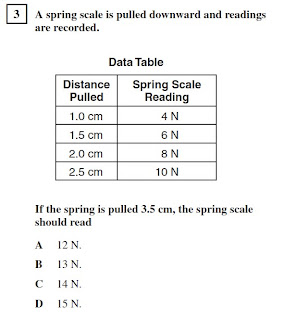
My only other guide is that they should keep the spirit of the question intact. Thus for:
Any other test prep suggestions are welcome.
Disclaimer - I'm not a big believer in test prep, but my school is. We're a "persistently low-achieving school" according to various governing bodies so I don't fault them for feeling the squeeze. One of the things the higher ups in my district think might be helpful (editor's note:no comment) is to print out a copy of the released test questions [pdf] for every CST a student will be taking. So every 8th grader has 4 packets (math, ELA, science, social studies) crammed into the bottom of his or her backpack. Since my school spends 4 digits on these copies (editor's note:again, no comment) I feel I should use them somehow. They could have at least thrown me a bone by removing the multiple choice answers but alas......
I call it Make it Right but I'm sure it goes by other names. The instructions are simple. After selecting the correct answer the students need to rewrite the question so that the other choices now become correct. Example:

After selecting A as the right answer, they then redraw the problem three times to make the answer correct for B, C, and D.
This year, with my spanking new whiteboards, I'll just assign each kid a letter and have him/her take that letter for every question (Student 1 is responsible for all the A responses, Student 2 for all the B responses, etc). We can quarter the whiteboards and have the kids share around their four-person group.
Sometimes it gets a little weird like in this one:

There really isn't a situation (at least that would ever come up in our level of science) where anything but C would be correct. In this case I just ask them to justify why A, B, and D can't ever be the correct answer.
My only other guide is that they should keep the spirit of the question intact. Thus for:

I want them to try to adjust the numbers in the table, rather than, for example, write an F=ma problem where the answer is 13 N.
Even for the plug and chug questions, this exercise takes a good amount of understanding and number sense. I don't feel bad about doing it and when asked I can say that I've been test prepping so it's a win-win.
Any other test prep suggestions are welcome.
Disclaimer - I'm not a big believer in test prep, but my school is. We're a "persistently low-achieving school" according to various governing bodies so I don't fault them for feeling the squeeze. One of the things the higher ups in my district think might be helpful (editor's note:no comment) is to print out a copy of the released test questions [pdf] for every CST a student will be taking. So every 8th grader has 4 packets (math, ELA, science, social studies) crammed into the bottom of his or her backpack. Since my school spends 4 digits on these copies (editor's note:again, no comment) I feel I should use them somehow. They could have at least thrown me a bone by removing the multiple choice answers but alas......
Saturday, February 5, 2011
Help Request: Physical Science Resources in Vietnamese
I got a couple of new students last week. Both are brand new in the country and understand very little English. I'm hoping someone out there in internet-land can point me to some physical science resources in Vietnamese.
I'll take pretty much anything. Digital or print. I have a Vietnamese-English glossary and a few helpful bilingual students. Mostly though, they just stare at me.1
Anything at the 8th grade intro level for....
Chemistry: Atomic Theory, Periodic Table
Physics: Motion (one-dimension, mostly finding speed/distance/time), forces and Newton's laws
Astronomy: Especially, objects in our solar system
I'm also struggling with helping them socially. The kids who come in from Mexico find a place pretty quickly. These two kids are truly "foreign." Oh and it's just coincidence they both came the same week. They are strangers, opposite sex, and have no befriended each other at all.
Leave a comment, twitter, or email me jybuell at gmail. Thanks.
1: I teach in a majority EL district, but that majority is almost entirely Spanish speaking. Before we cut a science teacher, I used to have a class devoted entirely to the CELDT 1 and 2 groups. I've always felt that teaching ELs was one of my strengths. It's been an incredibly jarring experience to feel completely lost here.
I'll take pretty much anything. Digital or print. I have a Vietnamese-English glossary and a few helpful bilingual students. Mostly though, they just stare at me.1
Anything at the 8th grade intro level for....
Chemistry: Atomic Theory, Periodic Table
Physics: Motion (one-dimension, mostly finding speed/distance/time), forces and Newton's laws
Astronomy: Especially, objects in our solar system
I'm also struggling with helping them socially. The kids who come in from Mexico find a place pretty quickly. These two kids are truly "foreign." Oh and it's just coincidence they both came the same week. They are strangers, opposite sex, and have no befriended each other at all.
Leave a comment, twitter, or email me jybuell at gmail. Thanks.
1: I teach in a majority EL district, but that majority is almost entirely Spanish speaking. Before we cut a science teacher, I used to have a class devoted entirely to the CELDT 1 and 2 groups. I've always felt that teaching ELs was one of my strengths. It's been an incredibly jarring experience to feel completely lost here.
Thursday, February 3, 2011
The Problem with Creating Problems
Words of warning, I have no answers here. I'm just thinking out loud and wanted to post a quote for future reference.
The third chapter of The Art of Problem Posing begins with an anecdote of a speaker relating the following observation to a group of math teachers:
What would you ask?
If you're like me you asked the, "How many handshakes..." question. The book states that the question was so obvious the speaker treated it as rhetorical, stated the question himself, and moved on with his talk. The authors then drop kick me in the head with this:
I had a strong reaction to reading Ashli's experience working with Dan Meyer's Boat in the River problem. When I sat in to watch Dan present this video (IIRC, there were about 20 of us and presumably, most of us were teachers), the "right"question was asked by nearly all of us. I recall being shocked that Ashli's students were so all over the place and only one group got the "right" question. In her shoes, I can imagine myself being mildly irritated at what appears to be kids shouting out random questions in attempts to be, ummm, kids.
Look at this question - "Why does he put the headphones in?"
I would definitely get this question. I would get it from the kid who is always trying to not-so-smoothly listen to his ipod by resting his head on his hand and running an earbud through his sleeve. He'd probably follow up the question with a statement about how Dan's ipod is old and the newer gen is much better. I'd be dismissive and move on.
Except.... I'm the one at fault here. It's actually quite interesting why he needs headphones and is certainly worth investigation. Discovering that Dan needs to maintain a constant speed only enriches the problem that I had intended for us to investigate originally. If you want to get crazy, the followup question, "What if he didn't maintain a constant speed?" opens up a whole new, and perhaps more interesting, investigation.
My tunnel vision is only exacerbated when I've taken the time to develop and create the problem myself. It's fairly easy for me to divorce myself from a lab I found on google. On the other hand, when I've taken hours to create a lab or demo in order to launch a specific investigation, I find myself invested in the idea that this demo so wonderfully elicits the question I'm hoping my students will ask so I can teach the thing I wanted to teach.
Stepping back and allowing the process of problem solving and problem posing to grow organically is something I struggle with daily.
It hurts my brain to think about how often I've limited questions because I've imposed my own context.
The third chapter of The Art of Problem Posing begins with an anecdote of a speaker relating the following observation to a group of math teachers:
There are nine Supreme Court Justices. Each year, in an act of cordiality the Supreme Court session begins with each judge shaking hands with every other judge. (p. 19)He then asks what the question was for this setup.
What would you ask?
If you're like me you asked the, "How many handshakes..." question. The book states that the question was so obvious the speaker treated it as rhetorical, stated the question himself, and moved on with his talk. The authors then drop kick me in the head with this:
Many of us are blinded to alternative questions we might ask about any phenomenon because we impose a context on the situation, a context that frequently limits the direction of our thinking. We are influenced by our own experiences and frequently are guided by specific goals (e.g., to teach something about permutations and combinations), even if we may not be aware of having such goals.
The ability to shift context and to challenge what we have taken for granted is as valuable a human experience as creating a context in the first place. (emphasis added because it's so awesome)
I had a strong reaction to reading Ashli's experience working with Dan Meyer's Boat in the River problem. When I sat in to watch Dan present this video (IIRC, there were about 20 of us and presumably, most of us were teachers), the "right"question was asked by nearly all of us. I recall being shocked that Ashli's students were so all over the place and only one group got the "right" question. In her shoes, I can imagine myself being mildly irritated at what appears to be kids shouting out random questions in attempts to be, ummm, kids.
Look at this question - "Why does he put the headphones in?"
I would definitely get this question. I would get it from the kid who is always trying to not-so-smoothly listen to his ipod by resting his head on his hand and running an earbud through his sleeve. He'd probably follow up the question with a statement about how Dan's ipod is old and the newer gen is much better. I'd be dismissive and move on.
Except.... I'm the one at fault here. It's actually quite interesting why he needs headphones and is certainly worth investigation. Discovering that Dan needs to maintain a constant speed only enriches the problem that I had intended for us to investigate originally. If you want to get crazy, the followup question, "What if he didn't maintain a constant speed?" opens up a whole new, and perhaps more interesting, investigation.
My tunnel vision is only exacerbated when I've taken the time to develop and create the problem myself. It's fairly easy for me to divorce myself from a lab I found on google. On the other hand, when I've taken hours to create a lab or demo in order to launch a specific investigation, I find myself invested in the idea that this demo so wonderfully elicits the question I'm hoping my students will ask so I can teach the thing I wanted to teach.
Stepping back and allowing the process of problem solving and problem posing to grow organically is something I struggle with daily.
It hurts my brain to think about how often I've limited questions because I've imposed my own context.
Monday, December 13, 2010
The Weekly Portfolio
I'll admit something. I've never liked the portfolio system of grading. As it was explained to me, and as I've seen it implemented, students gathered their work throughout a grading period. At the end of it, they submitted a portfolio. In better systems, students would sit with teachers and explain each piece that was submitted. The teacher and student would talk about it, like an artist talking about his/her work. It sounds wonderful. In practice though, I never got it.
Two big issues. The first is that it seemed to represent what a student knew, not what they currently know. I'd have issues with someone's best work being done in October. Second, it didn't seem to guarantee any sustained performance. Throw enough crap at the wall, eventually something will stick (this blog is a good example of that).
Toss in the fact that almost nobody has time for the critical interview portion—unless it's a schoolwide thing like a student-led conference—and you have a system that's assessing Young MC on Bust a Move and not the rest of Stone Cold Rhymin'. Or only using Sixth Sense when considering M. Night Shyamalan for a lifetime achievement award for film making.
It wasn't until a few weeks ago I realized that I had been using a portfolio system. It was just weekly.1
I've already mentioned my students keep track of their quiz scores in a folder. In the prongs they keep the tracking sheets and any other thing I need them to keep handy, like their benchmark scores and their periodic table. On the left side pocket they just keep stuff. Usually current quizzes. I don't really look at that side. On the right side they put anything they definitely want me to look at. Usually these are the quizzes, worksheets, or whatever that they think represent their current best efforts.
Additionally, in their science notebooks, they're supposed to put a sticky note if they want to draw my attention to anything they think I should look at. In practice, I've been bad about keeping up with the sticky notes because I suck about going to office depot and they're champs at turning all my post-it notes into flip books. My students are pretty good at drawing my attention though, either by folding a corner or drawing pink glitter hearts that say LOOK HERE.
A more organized version of me would also have them occasionally write justifications for why they want me to look at each piece of work. Maybe that me will arrive next year. As I'm typing this, I'm realizing that simply writing the standard number on anything submitted would be a good start and is so obvious I feel dumb for not thinking about it sooner. Hooray for blogging!
I still look at other things. I think it's important to take a look at the whole game. But the thing that's always appealed to me about the portfolio system is having students self-select what he or she perceives as quality. Developing the skills of self-evaluation is probably the most important thing I want a student to get out of standards-based grading.
1: And by weekly I mean, 3 out of every 5 weeks when none of my children are sick.
Two big issues. The first is that it seemed to represent what a student knew, not what they currently know. I'd have issues with someone's best work being done in October. Second, it didn't seem to guarantee any sustained performance. Throw enough crap at the wall, eventually something will stick (this blog is a good example of that).
Toss in the fact that almost nobody has time for the critical interview portion—unless it's a schoolwide thing like a student-led conference—and you have a system that's assessing Young MC on Bust a Move and not the rest of Stone Cold Rhymin'. Or only using Sixth Sense when considering M. Night Shyamalan for a lifetime achievement award for film making.
It wasn't until a few weeks ago I realized that I had been using a portfolio system. It was just weekly.1
I've already mentioned my students keep track of their quiz scores in a folder. In the prongs they keep the tracking sheets and any other thing I need them to keep handy, like their benchmark scores and their periodic table. On the left side pocket they just keep stuff. Usually current quizzes. I don't really look at that side. On the right side they put anything they definitely want me to look at. Usually these are the quizzes, worksheets, or whatever that they think represent their current best efforts.
Additionally, in their science notebooks, they're supposed to put a sticky note if they want to draw my attention to anything they think I should look at. In practice, I've been bad about keeping up with the sticky notes because I suck about going to office depot and they're champs at turning all my post-it notes into flip books. My students are pretty good at drawing my attention though, either by folding a corner or drawing pink glitter hearts that say LOOK HERE.
A more organized version of me would also have them occasionally write justifications for why they want me to look at each piece of work. Maybe that me will arrive next year. As I'm typing this, I'm realizing that simply writing the standard number on anything submitted would be a good start and is so obvious I feel dumb for not thinking about it sooner. Hooray for blogging!
I still look at other things. I think it's important to take a look at the whole game. But the thing that's always appealed to me about the portfolio system is having students self-select what he or she perceives as quality. Developing the skills of self-evaluation is probably the most important thing I want a student to get out of standards-based grading.
1: And by weekly I mean, 3 out of every 5 weeks when none of my children are sick.
Subscribe to:
Posts (Atom)